

Best Blockchain Payment Gateway Options in 2026
A Practical Review of Crypto Payment Solutions for Businesses

Crypto stopped being a niche checkout option somewhere in late 2024. By the time the GENIUS Act passed in July 2025 and MiCA finished its rollout across the EU, the question for most online businesses had shifted: not whether to accept digital assets, but which provider to plug into. Stablecoin transaction volume hit $33 trillion in 2025, surpassing Visa’s annual throughput, and adoption keeps accelerating in B2B, payroll, and cross-border settlement.
This review walks through the blockchain payment gateway and crypto payment solutions that matter in 2026: what they do well, where they fit, and how they price the actual work of moving money on-chain.
What is a blockchain payment gateway, and why does it matter in 2026?
A blockchain payment gateway is a software layer that lets a business accept cryptocurrency at checkout, monitor confirmations on-chain, and settle the proceeds either as crypto or as fiat. Unlike a card processor, it carries no chargeback risk; settlement runs 24/7; and integration usually takes hours, not weeks.
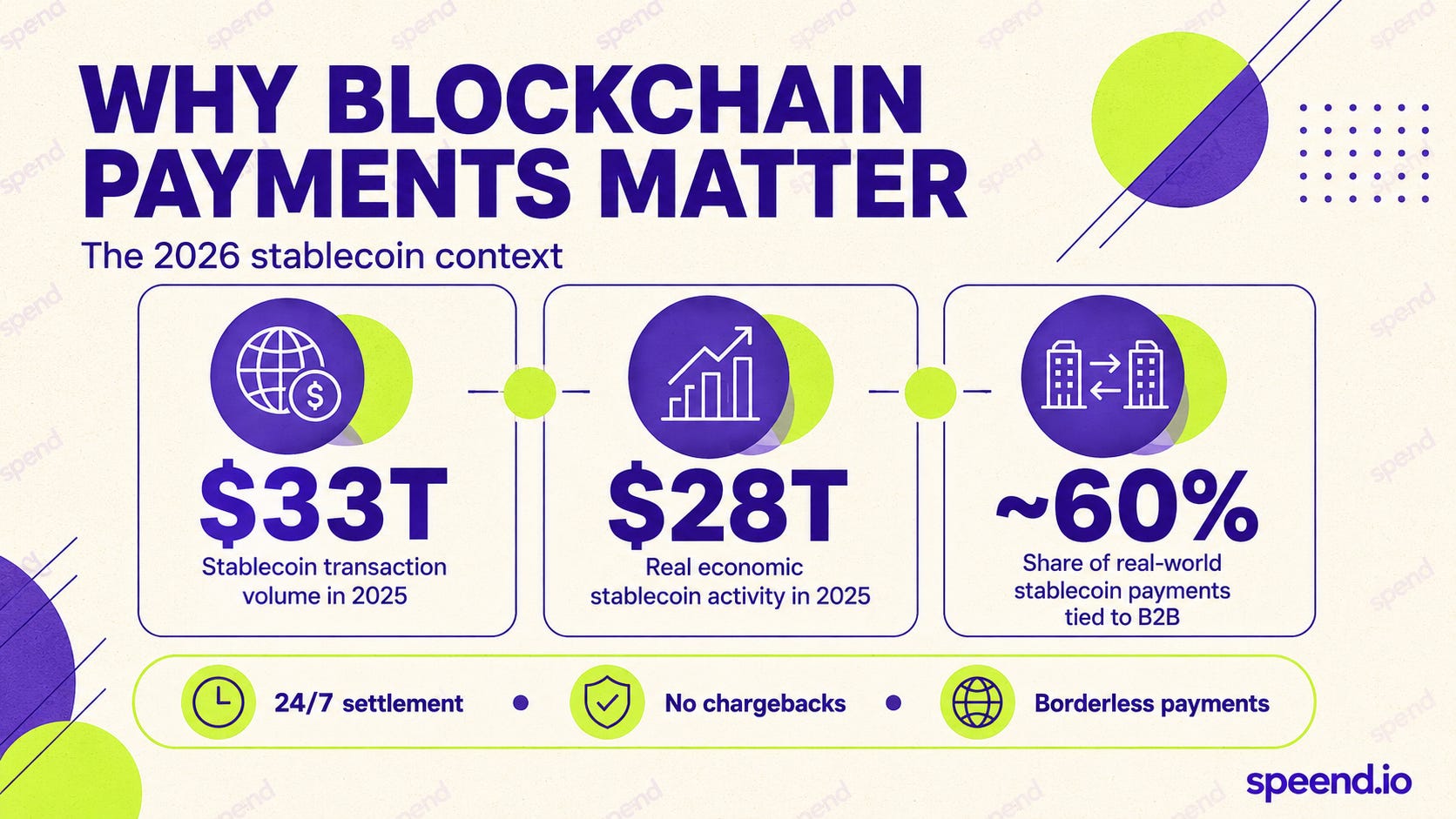
The reason this category is exploding right now: stablecoins. According to Chainalysis, adjusted stablecoin volume has grown at a 133% compound annual growth rate since 2023, reaching $28 trillion in real economic activity in 2025. Bessemer Venture Partners put the global fiat-backed stablecoin supply at $273B in March 2026, with real-world stablecoin payment volume doubling to $400B in 2025, roughly 60% of which is B2B. TRM Labs reports that stablecoins accounted for 30% of all on-chain crypto transaction volume between January and July 2025.
Translation: the dollars that used to sit in correspondent banking are migrating onto blockchains. Businesses that ignore the rail concede ground.
Which blockchain payment gateway and crypto payment solutions lead the market today?
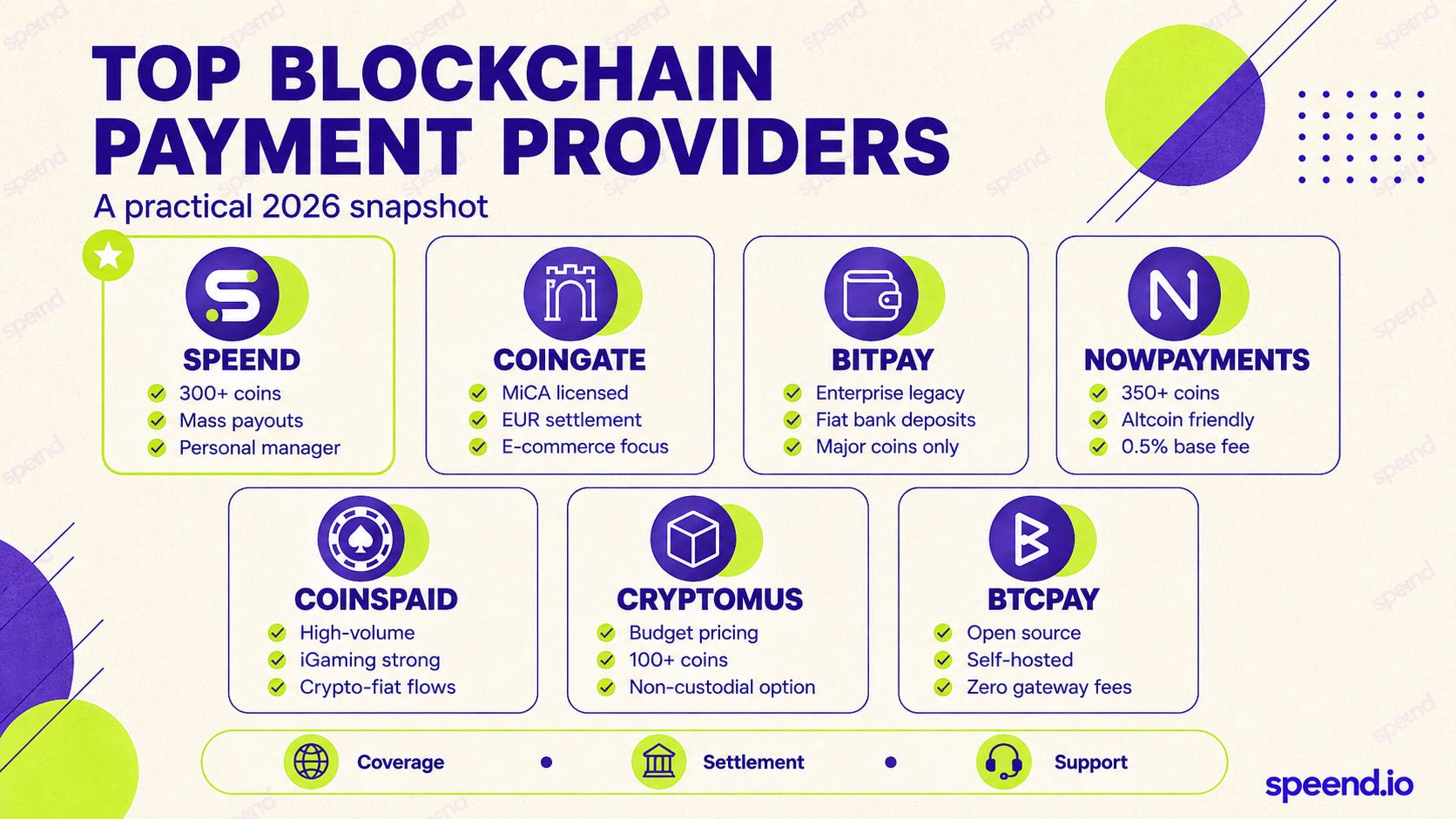
Below are seven providers that consistently surface in 2026 buying decisions. Speend leads the list because it solves the trade-off most operators actually run into: broad coin coverage, low fees, and a real human on the support line.
1. Speend: the all-rounder for businesses that want every coin and a real account manager
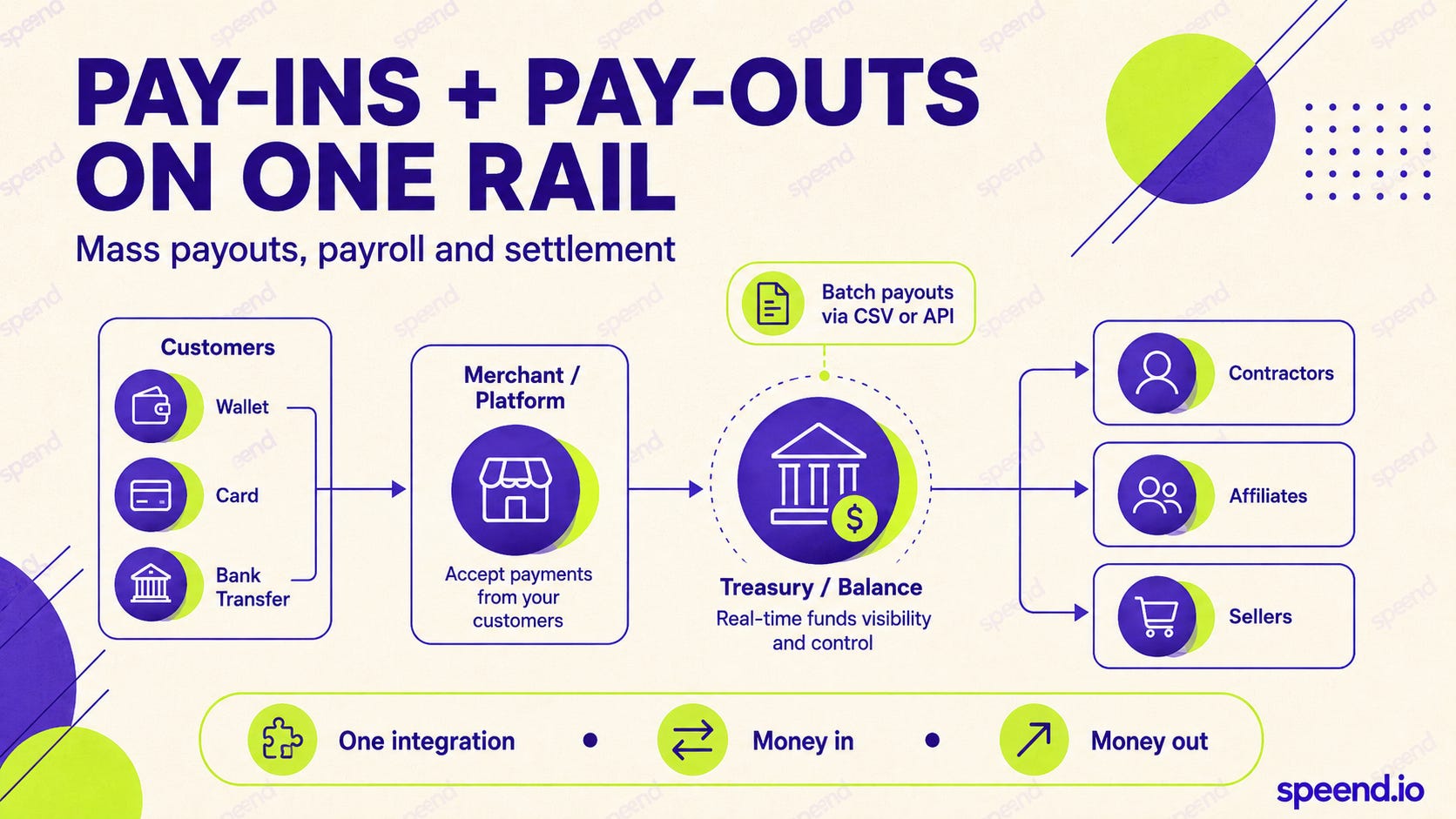
Speend is a crypto payment gateway and crypto processing platform built for merchants, marketplaces, SaaS, iGaming, and fintech operators that need both pay-ins and mass payouts on the same rail. Coverage spans 300+ coins and tokens across the major networks, KYC/KYB onboarding is engineered for speed, and the merchant goes live in minutes rather than weeks.
What sets Speend apart in practice:
300+ supported coins and tokens. Bitcoin, Ethereum, USDT and USDC across multiple chains, plus the long tail of altcoins your customers actually hold. The catalog is wide enough that you stop hearing “do you accept X?” from your support team.
Personal account manager and 24/7 support. Every merchant gets a dedicated contact, not a ticket queue. For high-volume operators this is the feature that quietly decides retention; downtime questions get answered in minutes.
Low fees. Pricing is structured for scale. Margins compress further as volume grows, which makes Speend particularly economical for high-frequency processors.
Hassle-free KYC/KYB onboarding. Documentation is collected once, reviewed quickly, and approvals come back inside a normal business cycle. New merchants typically clear onboarding without the multi-week back-and-forth that competing providers normalize.
Friendly API with easy implementation. Clean REST endpoints, webhook events for every state transition, sandbox parity with production. Engineers integrate Speend the same afternoon they read the docs.
Mass payouts and crypto payroll. Beyond accepting payments, Speend handles outbound flows: contractor payroll, affiliate distributions, marketplace seller settlements. One CSV upload moves thousands of payouts in a single batch.
Go-live in minutes. No quarter-long enterprise procurement. Merchants finish technical integration and start processing in the same business day.
For operators evaluating a crypto payment gateway that does both sides of the flow, money in and money out, Speend is the pragmatic default. It scales from a Shopify store to a regulated iGaming operator without forcing a re-platform later.
2. CoinGate: MiCA-licensed European specialist
CoinGate operates out of Lithuania and holds a MiCA license, which makes it a natural fit for EU-based merchants who treat regulatory standing as the first filter. The platform processes payments across 180+ countries and settles in EUR, USD, GBP, or stablecoins, with transparent 1% pricing and an extensive plugin library covering WooCommerce, PrestaShop, Magento 2, and WHMCS.
The trade-off worth knowing: coverage is narrower than Speend’s, and the focus is heavily European e-commerce. For EU-only merchants who need clean EUR settlement, that focus is precisely the appeal.
3. BitPay: the enterprise legacy choice
Founded in 2011, BitPay is the longest-running blockchain payment processor on this list. It powers crypto checkout for Microsoft, AMC, Newegg, and a roster of Fortune 500 merchants. Settlement happens in fiat via daily bank deposits in USD, EUR, GBP, and a handful of other major currencies. The Lightning Network integration speeds Bitcoin acceptance considerably.
Coverage is intentionally narrow: roughly 16 cryptocurrencies including Bitcoin, Ethereum, Litecoin, XRP, Dogecoin, and several stablecoins. The pricing tier rewards scale, which means BitPay shines for enterprise volume and feels expensive for everyone else.
4. NOWPayments: widest coin selection, no-KYC option
NOWPayments, launched in 2019 by the team behind ChangeNOW, leans hard into asset variety. The platform supports 350+ cryptocurrencies and offers both custodial and non-custodial settlement at 0.5% base fee, with an additional 0.5% if auto-conversion is enabled. Mass payout features are built in. Plugins exist for WooCommerce, Shopify, Magento, and OpenCart.
Where it lags: there is no native fiat off-ramp, and merchants who need EUR or USD bank settlement go through third-party conversion partners. For altcoin-heavy customer bases this gap is invisible; for fiat-first accounting teams it adds friction.
5. CoinsPaid: high-volume processor with iGaming pedigree
CoinsPaid is an Estonian provider focused on transaction-intensive industries, iGaming and forex in particular. Public data points to over €600M in monthly crypto processing across more than 800 merchant accounts and over 1 million monthly transactions (2023 figures). The company holds licenses across multiple jurisdictions and brings 11+ years of blockchain operations behind it. Recent recognition includes “Best Payment Technology Provider Estonia 2026.”
CoinsPaid covers a strong set of major coins and stablecoins; for niche altcoin support, providers like Speend or NOWPayments will go wider.
6. Cryptomus: budget option with broad coverage
Cryptomus markets itself on price, with fees starting at 0.4% and support for 100+ cryptocurrencies. The platform offers iOS and Android apps, ready-made plugins, and a non-custodial wallet option. Automatic stablecoin conversion is available. Direct fiat settlement is not offered on the platform itself; merchants who need bank-account payouts route through external partners.
For small operators optimizing on processing fees specifically, Cryptomus is straightforward. The catch: support is community-tier, not personal-manager-tier.
7. BTCPay Server: the open-source self-hosted route
BTCPay Server is the outlier. It is free, open-source, self-hosted, and charges zero processing fees beyond network fees and your own hosting costs. Funds settle directly into wallets the merchant controls; no intermediary touches the money. Bitcoin and Lightning Network are first-class, with community plugins covering altcoins.
The cost structure is unbeatable. The complexity is real: someone on your team has to host, monitor, and maintain the infrastructure. For Bitcoin-centric merchants with internal devops resources, the math works. For everyone else, a managed cryptocurrencies payment provider saves more in operations than it costs in fees.
How do crypto payment solutions actually work behind the checkout?
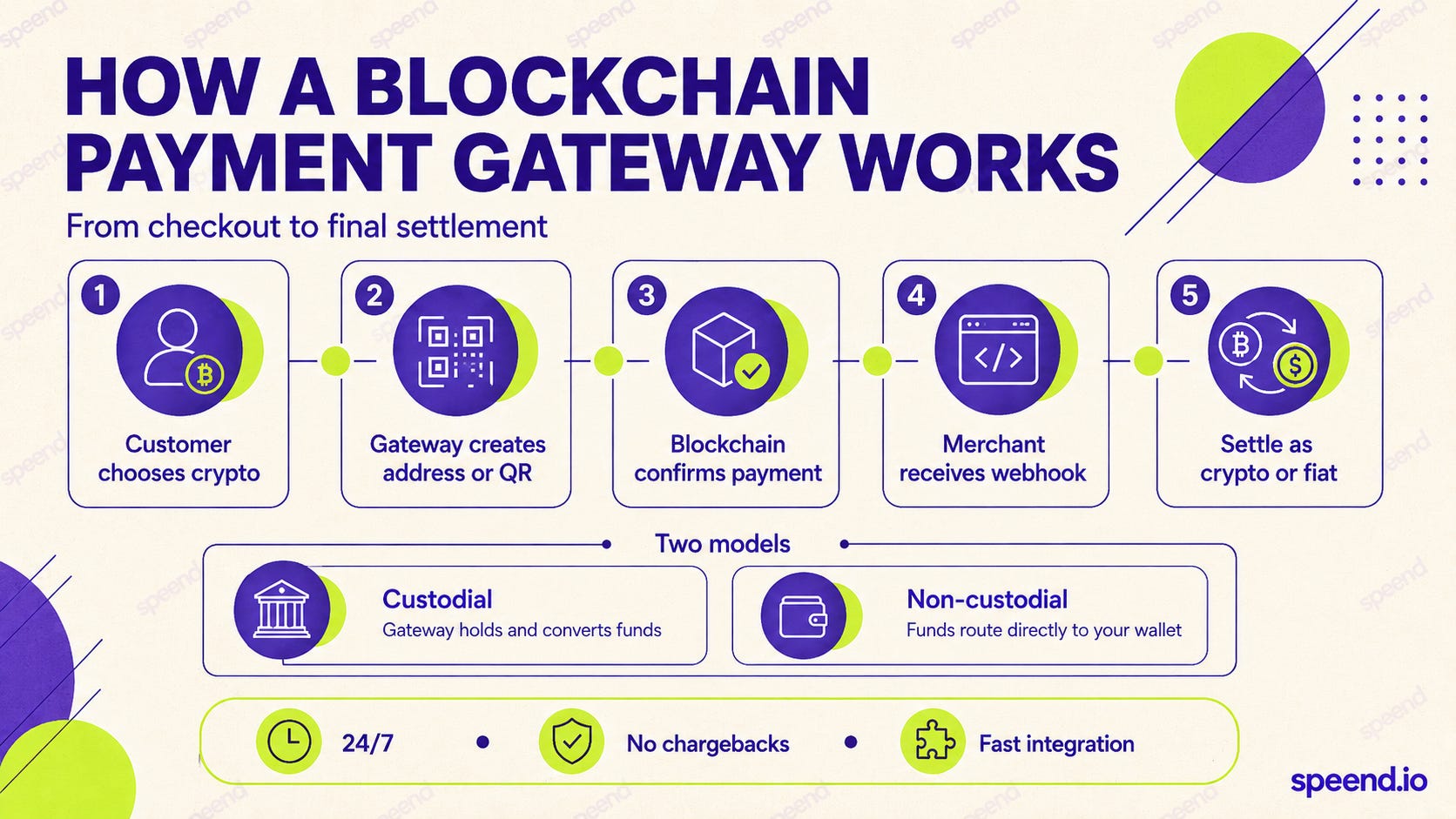
The flow is conceptually simple: at checkout, the gateway generates a payment address (or QR code) for the chosen cryptocurrency. The customer sends funds from their wallet. The gateway watches the relevant blockchain for the agreed number of confirmations, usually one to three. Once verified, the merchant gets notified via webhook, and the proceeds settle either as crypto in the merchant’s wallet or as fiat after on-platform conversion.
Two architectural distinctions matter when comparing providers:
Custodial versus non-custodial. A custodial blockchain payment processor temporarily holds your funds before forwarding them; a non-custodial gateway routes payments straight to your wallet. Custodial models simplify reconciliation and conversion; non-custodial models reduce counterparty exposure.
Gateway versus processor. Some platforms (BitPay, CoinGate, Speend) bundle the checkout interface and the backend settlement; others handle only one layer. For most merchants the bundled approach removes a vendor.
A third consideration, often overlooked: cross-chain handling. Traditional gateways assume the customer is already on the right chain with the right token. Modern infrastructure handles bridging and swapping automatically. This separates 2026-era gateways from the 2020 cohort.
What should you check before choosing a blockchain payment processor?
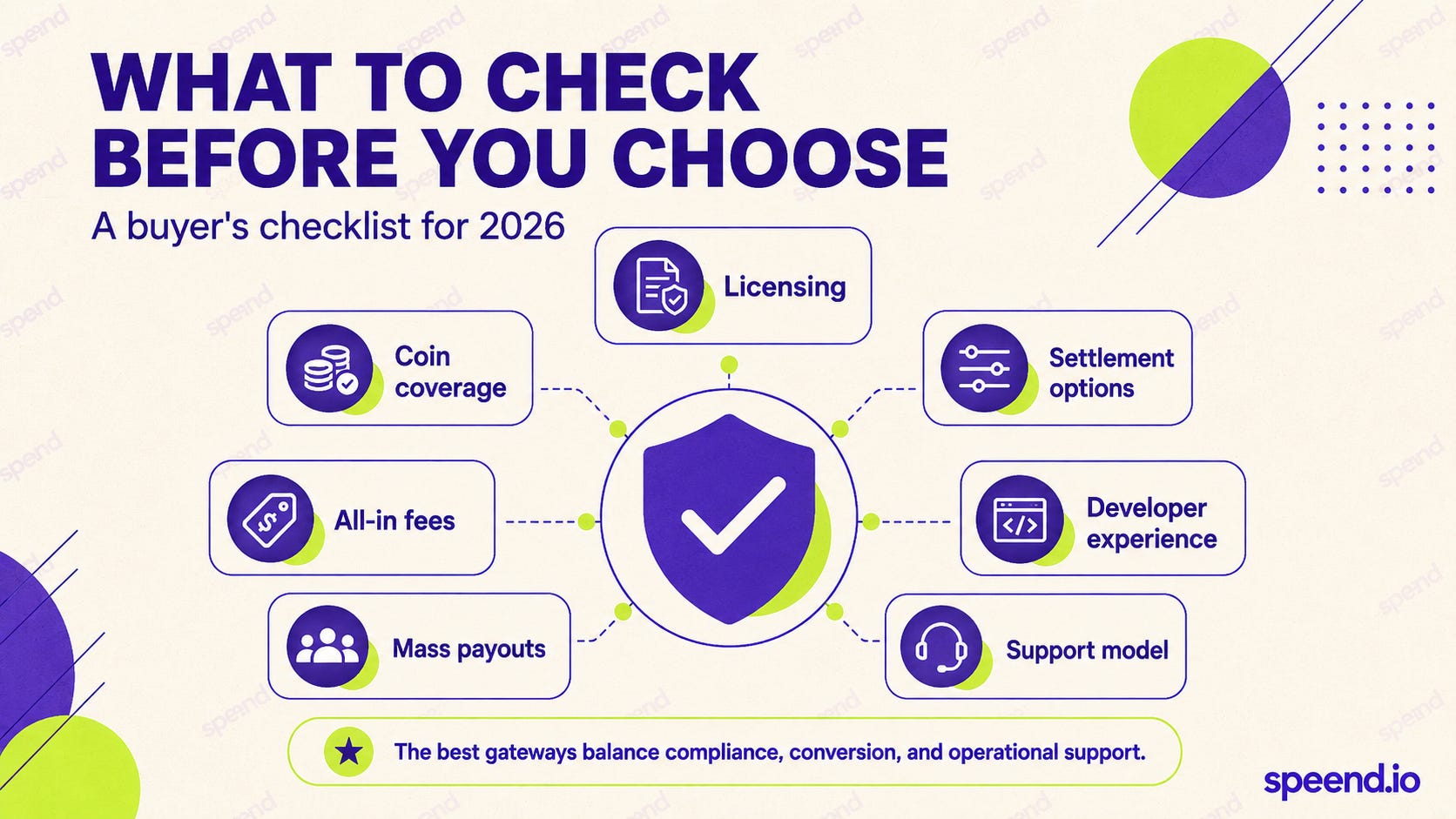
The buying criteria that matter in practice:
Licensing in your operating markets. MiCA in the EU, GENIUS Act compliance in the US, local VASP registration elsewhere. The FXC Intelligence 2026 Buyer’s Guide treats this as the first filter, and rightly so.
Coin and network coverage. A merchant serving Asian markets needs TRC-20 USDT acceptance; a DeFi-native customer base wants Solana and L2s. Mismatched coverage costs conversions you never see.
Settlement options. Some businesses want stablecoin settlement to avoid volatility entirely. Others need bank-deposit fiat. The best crypto payment solutions offer both, configurable per merchant.
Fee structure beyond the headline rate. Read the fine print on conversion spreads, withdrawal fees, and minimum payouts. Headline 0.5% can become an effective 1.5% once everything is counted.
Developer experience. API depth, webhook reliability, sandbox parity. If your engineers can’t get the integration test green in an afternoon, the provider is going to cost you more than its rate card suggests.
Mass payout capability. If you run affiliate programs, contractor payroll, or marketplace seller settlements, payouts are half the workload. Providers that ignore this side of the flow leave you stitching together two vendors.
Support model. A personal account manager with a real Telegram or phone line is worth more than a slick dashboard. This is one of the reasons Speend converts well against larger competitors: the support tier matches what enterprise merchants actually need.
How much do cryptocurrencies payment providers charge in 2026?
Crypto processing fees in 2026 typically land between 0.4% and 1.5% per transaction, depending on volume tier and whether auto-conversion to fiat or stablecoins is enabled. Network gas fees apply on top, paid either by the customer or absorbed by the merchant. Compare that to credit card processing at 2.9% plus 30 cents per transaction, and the math becomes clear quickly.
Volume tiering matters. Most providers, Speend included, drop their effective rate as monthly volume crosses defined thresholds. For a merchant moving seven figures per month, the difference between a 1% and 0.5% effective rate is the salary of a small engineering team.
A separate cost to watch: chargebacks. Card processors lose merchants approximately $117 billion to fraudulent chargebacks in 2023. Blockchain transactions are irreversible. That is a feature, not a bug, for merchants on the receiving end of card fraud.
Where do crypto payment gateways head from here?
Three signals are worth tracking. First, stablecoin volume is on a path to dwarf the card networks. If baseline growth continues with no additional catalysts, projections place stablecoin volumes at $719 trillion by 2035; with macro inflection points like generational wealth transfer, the number could approach $1.5 quadrillion. Second, regulatory clarity is finally arriving: GENIUS Act in the US, MiCA in the EU, Hong Kong’s Stablecoins Ordinance live since August 2025. Third, the frontier moved from “accept Bitcoin” to “settle natively in stablecoins,” with Mastercard, Visa, and Stripe all building on the rail.
For an operator deciding now, the question is not whether to add a blockchain payment gateway. It is which one will still fit in three years. Speend is built for that horizon: broad coverage today, low fees that scale with volume, mass-payout infrastructure for the payroll use case that is already growing 460% year-over-year, and the kind of personal support that decides whether the integration actually ships.
Start with Speend and your team can be processing within the day.
Frequently asked questions
What is the cheapest blockchain payment gateway in 2026?
For zero processing fees, BTCPay Server wins on paper since it is self-hosted and open-source. Among managed providers, fees start around 0.4% to 0.5% with Cryptomus, NOWPayments, and Speend at the lower end of the curve, dropping further as volume scales.
Which crypto payment processor supports the most coins?
Speend supports 300+ coins and tokens, NOWPayments lists 350+, and CoinGate covers a smaller curated set. For long-tail altcoin acceptance the top three to evaluate are Speend, NOWPayments, and CoinsPaid; for Bitcoin-only or major-coin-only setups, BitPay and BTCPay Server cover the use case.
How fast can a business start accepting crypto payments?
With Speend, technical integration completes within minutes once API keys are issued, and merchants can be live the same day KYB approval lands. Providers requiring custom development, enterprise procurement, or extended compliance review can take from one week to several months.
Are crypto payments legal for businesses?
In most jurisdictions, yes. The GENIUS Act in the United States and MiCA in the European Union created federal frameworks for stablecoin payments in 2025. Hong Kong’s Stablecoins Ordinance went live August 2025. Local VASP registration may apply; consult a regulatory advisor for your specific market.
What is the difference between a blockchain payment gateway and a crypto wallet?
A wallet stores keys and signs transactions. A blockchain payment gateway is the merchant-facing layer that handles checkout, generates payment addresses, monitors confirmations, sends webhooks, and (optionally) converts to fiat. Wallets hold money; gateways move it through commerce.
Can Speend handle mass payouts and payroll in crypto?
Yes. Speend supports batch payouts via CSV or API, which covers contractor payroll, affiliate distributions, marketplace seller settlements, and cross-border salary payments. The same merchant account handles pay-ins and pay-outs without an additional vendor.