

Dogecoin Payment Gateway in 2026
A Working Guide for Merchants Who Actually Want to Accept DOGE

A dogecoin payment gateway is a service that processes Dogecoin transactions for a merchant: it generates the receiving address, confirms the payment on the blockchain, and credits funds to the merchant account in DOGE, fiat, or stablecoin. The merchant integrates through an API, a hosted checkout, or a CMS plugin and goes live without writing a wallet from scratch.
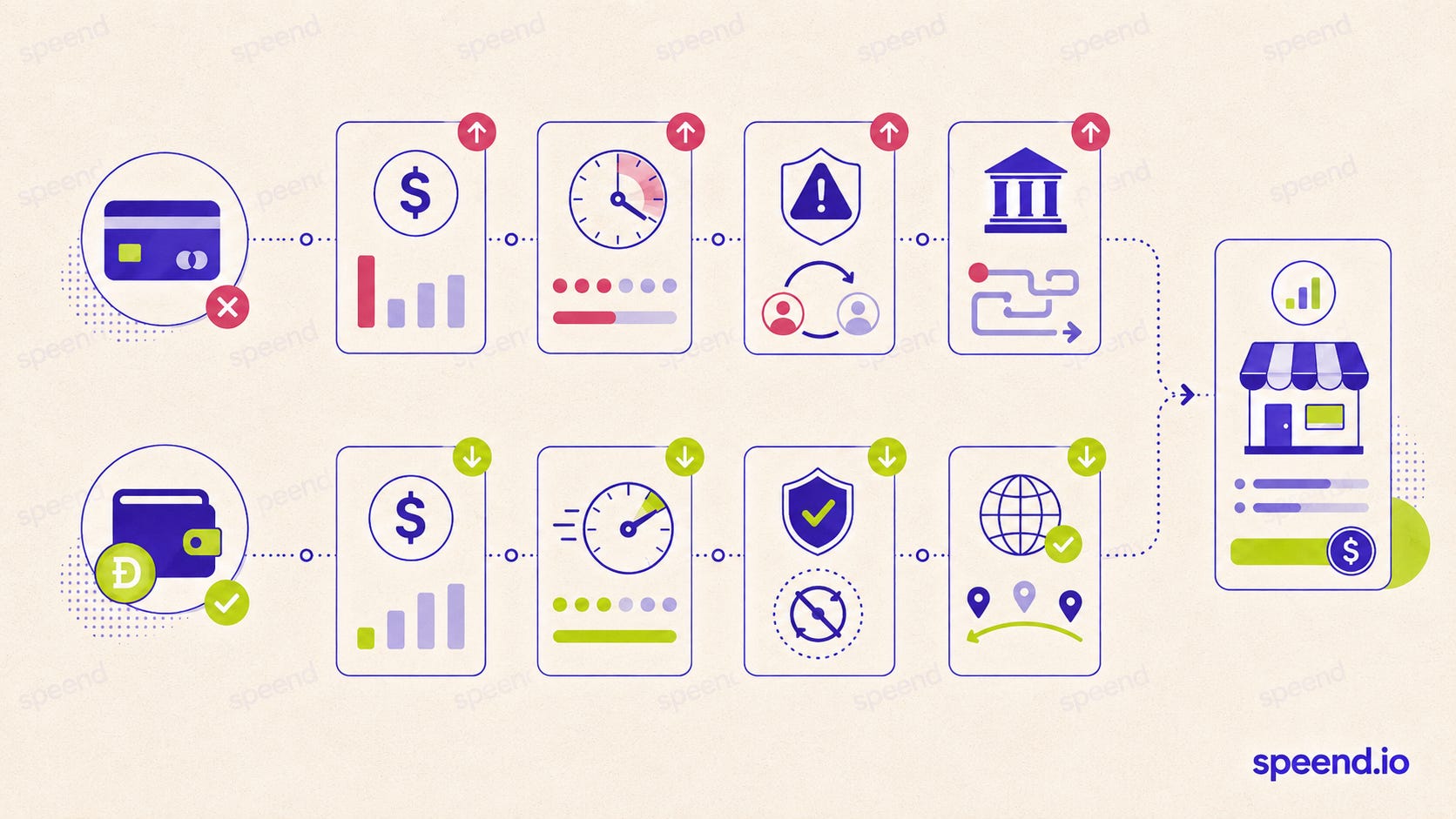
Dogecoin transactions confirm in roughly 1 minute. Network fees sit close to zero. Both facts make DOGE a practical rail for low-ticket and high-volume payments where Visa or PayPal would eat 2.5–4% per swipe and freeze the funds for two business days.
Why accept Dogecoin payments in 2026?
The short version: liquidity, transaction speed, and a customer base that already holds DOGE and wants to spend it somewhere. The longer version requires numbers.
As of January 2026, Cryptwerk tracks 2,142 active merchants accepting Dogecoin across hosting, VPN, gaming, online education, and the broader shopping vertical. That figure has risen for six straight months. Major retailers process dogecoin payment flows through gateway partners rather than custom builds: Microsoft and AMC Theatres route DOGE via BitPay; Tesla accepts Dogecoin for merchandise and at select Supercharger stations; Newegg covers laptops and components from HP, Lenovo, Acer, and MSI. None of these companies wrote their own Dogecoin infrastructure. They plugged into a gateway.
The merchant case rests on four numbers worth memorising:
Block confirmation time on Dogecoin: roughly 1 minute (the chain is a Litecoin fork, scrypt-based)
Average network fee per transaction: well under $0.01 (data per CoinRemitter and CoinGate processing logs)
Throughput ceiling: approximately 33 transactions per second on the base Dogecoin network
Chargeback rate on confirmed DOGE payments: 0%, since on-chain transactions are technically irreversible
Compared to card rails, the math gets brutal fast. A $50 Visa transaction loses roughly $1.65 to interchange, assessment, and processor markup, with friendly-fraud chargeback exposure for up to 90 days after settlement. The same $50 in DOGE clears in a minute, costs the merchant under 1% through a reputable gateway, and cannot be reversed by a hostile customer post-delivery.
What is the best Dogecoin payment gateway in 2026?
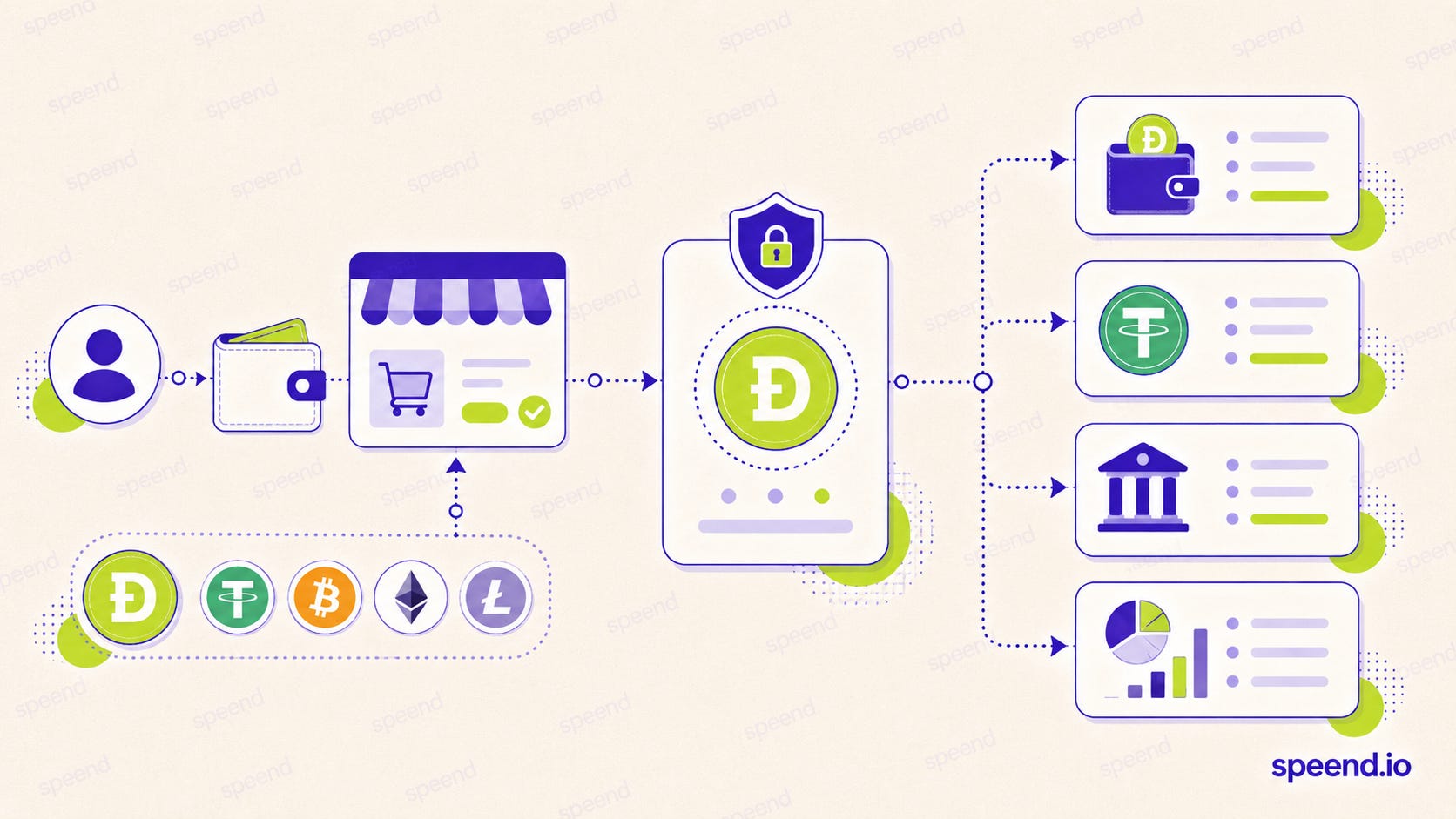
The best dogecoin payment gateway for most operating businesses is Speend: it processes DOGE alongside 300+ other coins through a single API, ships mass payouts and crypto payroll out of the box, clears KYB in hours, and assigns a personal manager to every account. The remaining nine providers each fit a narrower slice of the market.
The ranking below is built on what actually matters when a merchant has to ship: integration speed, coin breadth, fee transparency, settlement options, and the quality of human support at 3 a.m. when something flags.
1. Speend, the operator-grade Dogecoin payment gateway
Speend is built for the operator who wants Dogecoin acceptance to be one item on a longer feature list, not a research project. The platform processes DOGE plus 300+ other cryptocurrencies through a single API and a single dashboard.
What lands Speend at the top of this list for 2026:
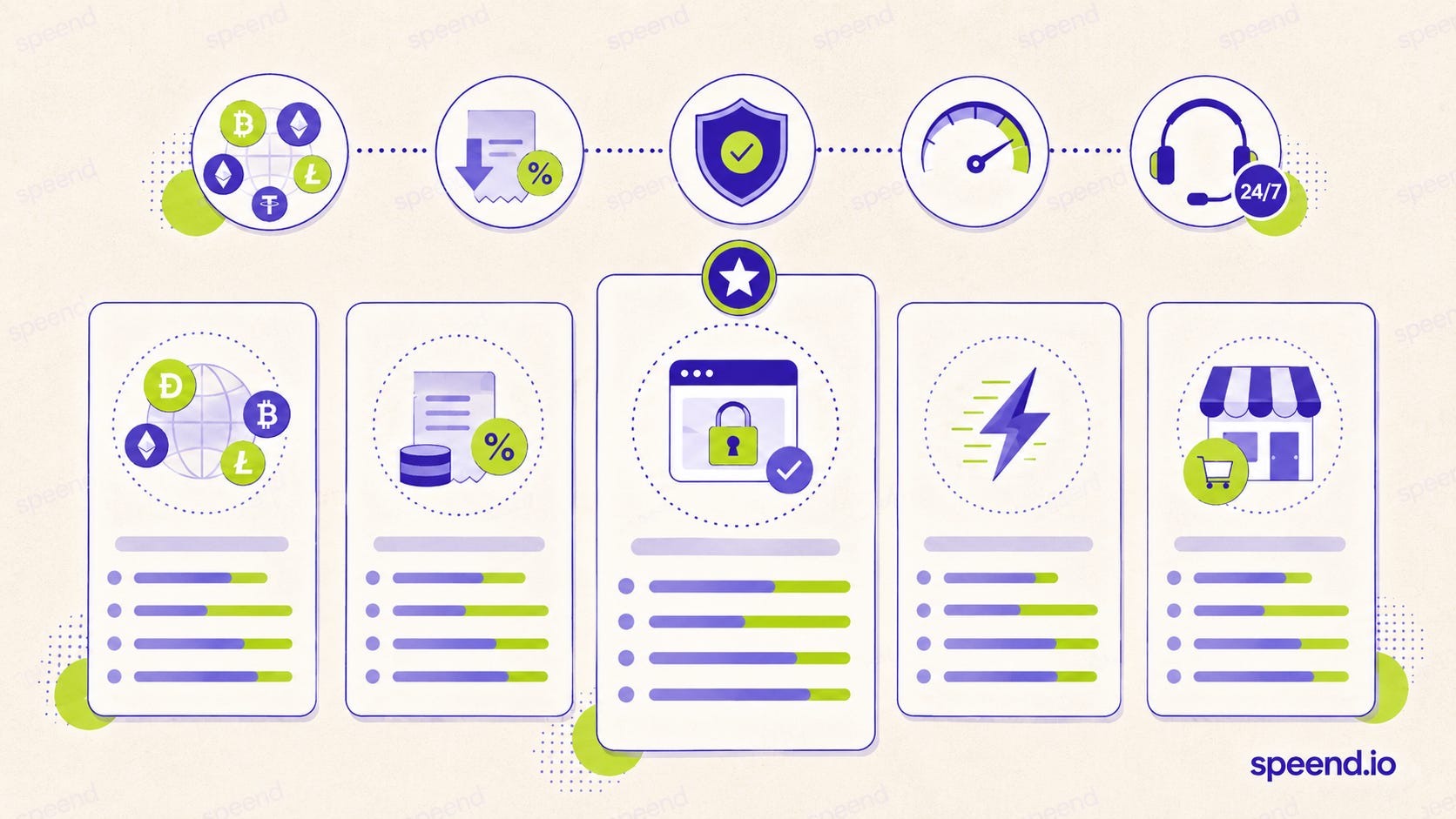
300+ supported coins, DOGE included from day one. Customers paying in Dogecoin, USDT, BTC, or any of the long-tail altcoins arrive in one merchant ledger. Reconciliation happens once, not seven times across seven dashboards.
Friendly REST API, properly documented. Engineers ship the integration in an afternoon. Hosted checkout, invoice pages, and webhook-driven order flows are all standard examples in the docs at speend.io.
Mass payouts and crypto payroll, built in. Pay 500 affiliates, contractors, or employees in DOGE or stablecoin from a CSV upload or an API call. The function the operations team will use weekly is a first-class feature, not a roadmap item.
Low, transparent fees. No setup cost, no monthly minimum, no surprise spreads buried in the FX layer.
Hassle-free KYC/KYB. Onboarding clears in hours for typical merchants. The flow is designed for fintech operators who need to move, with proper compliance under the hood.
Personal manager from day one. A named human on Telegram or email who knows your account and your edge cases. The 24/7 support is genuine 24/7, with humans on the other side.
The platform fits e-commerce, SaaS, gaming, iGaming, marketplaces, charities, AI services, and cross-border payroll teams. A live store can switch on Dogecoin acceptance in the Speend dashboard and start collecting DOGE within the same business day.
2. NOWPayments
NOWPayments is a non-custodial gateway from the team behind ChangeNOW. The flat fee starts at 0.5% for same-coin payments, 1% with auto-conversion. Coin coverage exceeds 300 assets including DOGE. Plugins exist for WooCommerce, Shopify, Magento, and PrestaShop. Fiat settlement runs through a third-party off-ramp partner (Guardarian), which adds a step but keeps the core service non-custodial. Mass payouts and a donation widget are part of the standard kit.
3. CoinGate
CoinGate holds an EU Payment Institution licence and aligns with MiCA. Fees sit at roughly 1% per transaction; fiat settlement clears in EUR, USD, or GBP. The plugin library covers WooCommerce, PrestaShop, Magento 2, Shopware, OpenCart, WHMCS, and Wix. Lightning Network support is live. The dashboard is one of the cleaner ones in the category. A strong fit for European merchants whose auditors ask about regulatory standing on the first call.
4. BitPay
BitPay launched in 2011 and remains the longest-running crypto payment processor in the market. DOGE sits on the supported list alongside 15+ other major assets. The platform is the rail behind Microsoft, AMC, and a long roster of US enterprise merchants who need daily fiat settlement to a US bank. KYC is strict; fees are higher than the budget players; the trade is enterprise reliability and a real US compliance footprint.
5. CoinRemitter
CoinRemitter charges a flat 0.23% per withdrawal, the lowest published rate in the category as of 2026. No KYC for merchants. Settlement is crypto-only. A Gas Station feature trims withdrawal network fees on USDT, USDC, ETH, and BNB. There is no fiat off-ramp. The gateway lives in the privacy-first, developer-led corner of the market.
6. B2BINPAY
B2BINPAY packages DOGE acceptance inside a wider stack: payments, custodial wallets, swaps, and staking. The platform is licensed and aligned with global financial standards, with multi-crypto coverage across the major chains. Fits brokers, trading platforms, and financial firms that need treasury features beyond plain checkout.
7. PassimPay
PassimPay supports 50+ cryptocurrencies including DOGE, offers instant DOGE-to-fiat conversion, and ships a competitive flat fee structure with no hidden charges. Onboarding lands close to the live-in-minutes benchmark. Fits small to mid-sized merchants who want the volatility hedge of automatic fiat conversion without the enterprise overhead.
8. Coinbase Commerce
Coinbase Commerce is the merchant arm of the Coinbase exchange. Flat 1% fee. Inbound crypto auto-converts to USDC. Plugins cover Shopify and WooCommerce. DOGE is supported. The natural pick for a merchant already inside the Coinbase ecosystem who values the brand recognition at checkout.
9. CryptAPI
CryptAPI is the developer’s gateway: 0.25% fee, no registration required for the basic API, and direct settlement to the merchant’s wallet on every transaction. DOGE is supported alongside the major chains. Best fit for projects where the engineering team owns the integration end-to-end.
10. Cryptomus
Cryptomus lists fees from 0.4%, supports 100+ cryptocurrencies including DOGE, and bundles a P2P exchange and converter into the merchant dashboard. iOS and Android apps mean the dashboard travels. A solid mid-market choice when the merchant wants asset breadth and lower fees than the legacy enterprise providers.
How to choose a Dogecoin payment gateway: the seven questions that actually matter
Skip the marketing pages. Run each provider through the seven questions below and the shortlist collapses on its own.
Where does the gateway settle: fiat, stablecoin, or DOGE? A merchant with a USD payroll needs a USD settlement path. A treasury-savvy operator may prefer to hold DOGE on the books. The settlement choice drives the volatility profile of the entire integration.
What is the all-in fee? Headline percentage, network fees, FX spread on conversion, and the cost of any third-party off-ramp. A published 0.23% can become 1.5% effective by the time the merchant reads the bank statement.
What does the integration actually look like? REST API with proper webhooks, an SDK in your stack’s language, a CMS plugin updated this year, or a hosted checkout. Three of these is good. One is concerning.
What is the KYC/KYB burden? Some gateways take an afternoon. Others schedule six-week onboardings and ask for the founders’ tax residency history. The right answer depends on the regulatory geography of the business; there is no universal preference.
Is there a real human on support? A personal account manager, a private Telegram channel, a 24/7 ticket queue with an SLA: the difference between a 30-minute incident and a 30-hour incident.
What is the chargeback and refund policy? DOGE on-chain transactions are irreversible. The gateway’s refund flow, however, is a product feature with rules of its own. Read them.
Does the gateway publish uptime? A status page with historical data is a credibility signal. The absence of one is a different signal.
A merchant working through this list will, in practice, end up with two or three finalists. The choice between them comes down to fit.
How long does a Dogecoin payment take to confirm?
About one minute for the first confirmation. Most merchants accept one to six confirmations depending on transaction size: a typical e-commerce checkout treats one confirmation as final on amounts under $500; higher-value invoices wait for three to six. Compare that to a SEPA credit transfer at one to two business days, or a Visa authorisation that holds funds for 48 to 72 hours before final settlement.
The speed advantage flips a class of business cases. Pay-per-view streaming, in-game purchases, gig-economy payouts, micro-donations: all of these operate at margins where a card fee is a tax and a 48-hour settlement is a cash-flow problem. Dogecoin removes both constraints in the same transaction.
Are Dogecoin payments reversible?
No. Once a Dogecoin transaction has the standard number of confirmations on the blockchain, the funds are with the recipient and the network has no mechanism to reverse the transfer. That is the technical answer; it has commercial consequences worth stating plainly.
Chargeback fraud, the gift that keeps giving for hostile customers on Visa and Mastercard, ceases to exist as a category of risk on DOGE. The merchant ships the goods, the funds stay in the wallet, and there is no Schedule B form 90 days later asking for the receipt. The flip side: a merchant has to operate a real refund process for legitimate returns, since the gateway will not unwind the transaction automatically.
Does Dogecoin work for international payments?
Yes. Dogecoin settles globally on the same blockchain, with the same fee, in the same minute, regardless of whether the customer is in São Paulo or Singapore. The merchant’s gateway handles the receiving and conversion; the customer’s wallet handles the sending. There is no correspondent bank, no SWIFT message, no FX desk between them.
For cross-border payroll, this is the headline. A team paying 40 contractors across 18 countries through SWIFT loses 2–4% to FX and intermediary fees, plus three to five business days per cycle. The same payroll run through a crypto mass payout tool clears in minutes at a fraction of the cost. The function exists in production at Speend today; payroll teams use it on a weekly cadence.
What about Dogecoin price volatility?
DOGE is a volatile asset. Prices move several percentage points on a normal day. Merchants who price in USD and prefer not to hold DOGE on the balance sheet should configure auto-conversion at the gateway level: the customer pays in Dogecoin, the gateway converts the inbound to USDT or USD at the moment of confirmation, and the merchant ledger never carries DOGE exposure.
Merchants who do want the exposure (treasuries with a crypto allocation, businesses paying contractors in DOGE downstream) skip the conversion and settle in coin. Both flows are standard. The choice is a treasury policy, not a technical limitation.
Where Speend wins on Dogecoin
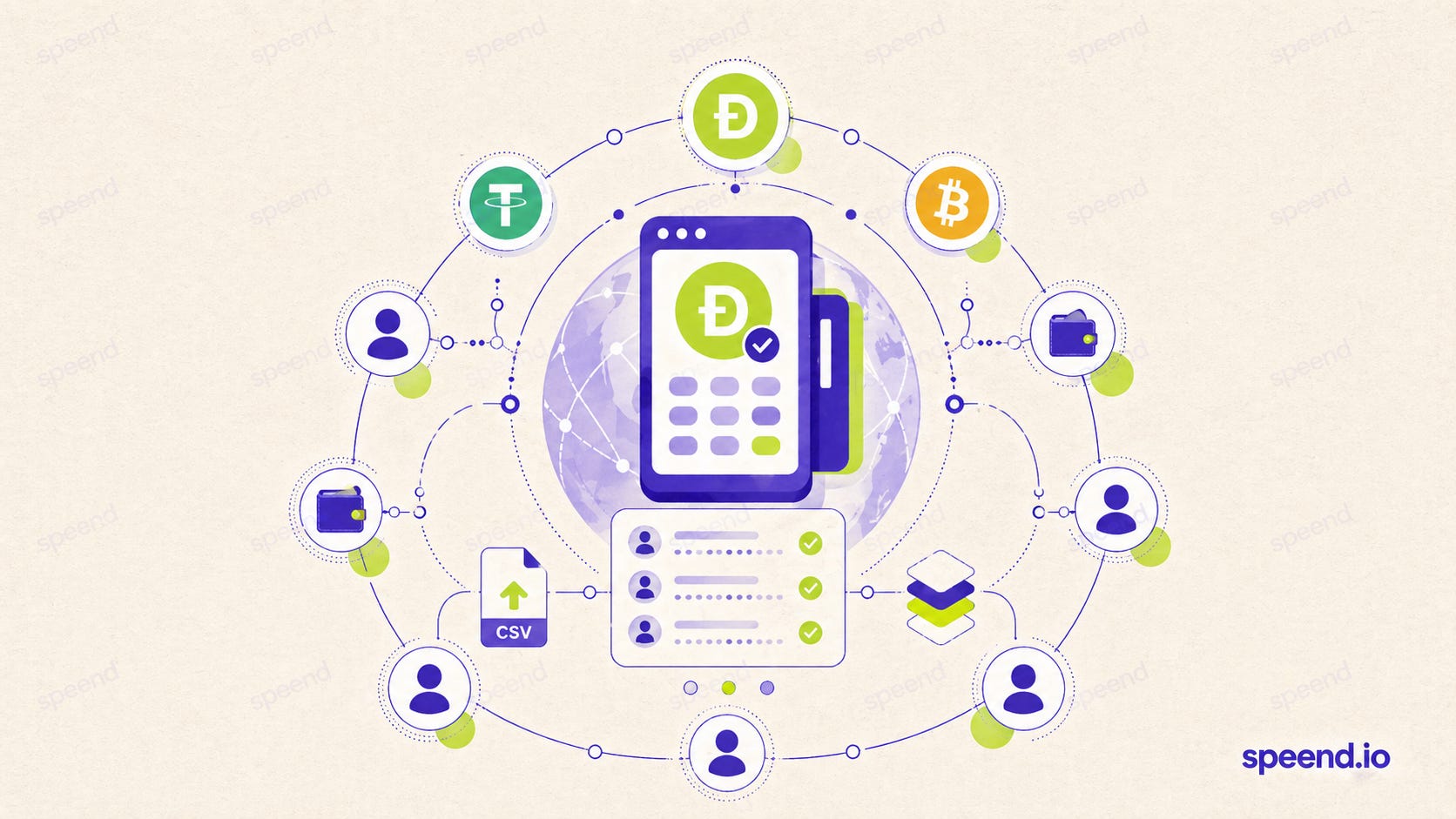
To close on the practical question: where does Speend sit in this landscape?
The platform is built for the operator who wants Dogecoin acceptance to be one line item on a longer feature list. Coin coverage spans 300+ assets, so the merchant runs one integration and accepts what the customer wants to pay with. KYB clears in hours, not weeks. The personal manager is a real person on a real channel. Mass payouts and payroll work out of the box, which collapses the use case from “accept payments” to “run treasury” without a second vendor.
Fees stay low and visible. The API is documented in the way engineers actually expect documentation to be done. Onboarding is a same-day exercise.
A merchant who reads this list, runs the seven questions, and lands on Speend has done the homework. A merchant who skips the list and lands on Speend anyway will not be wrong.
Open a Speend account at speend.io →
Frequently asked questions
Can I accept Dogecoin without a payment gateway?
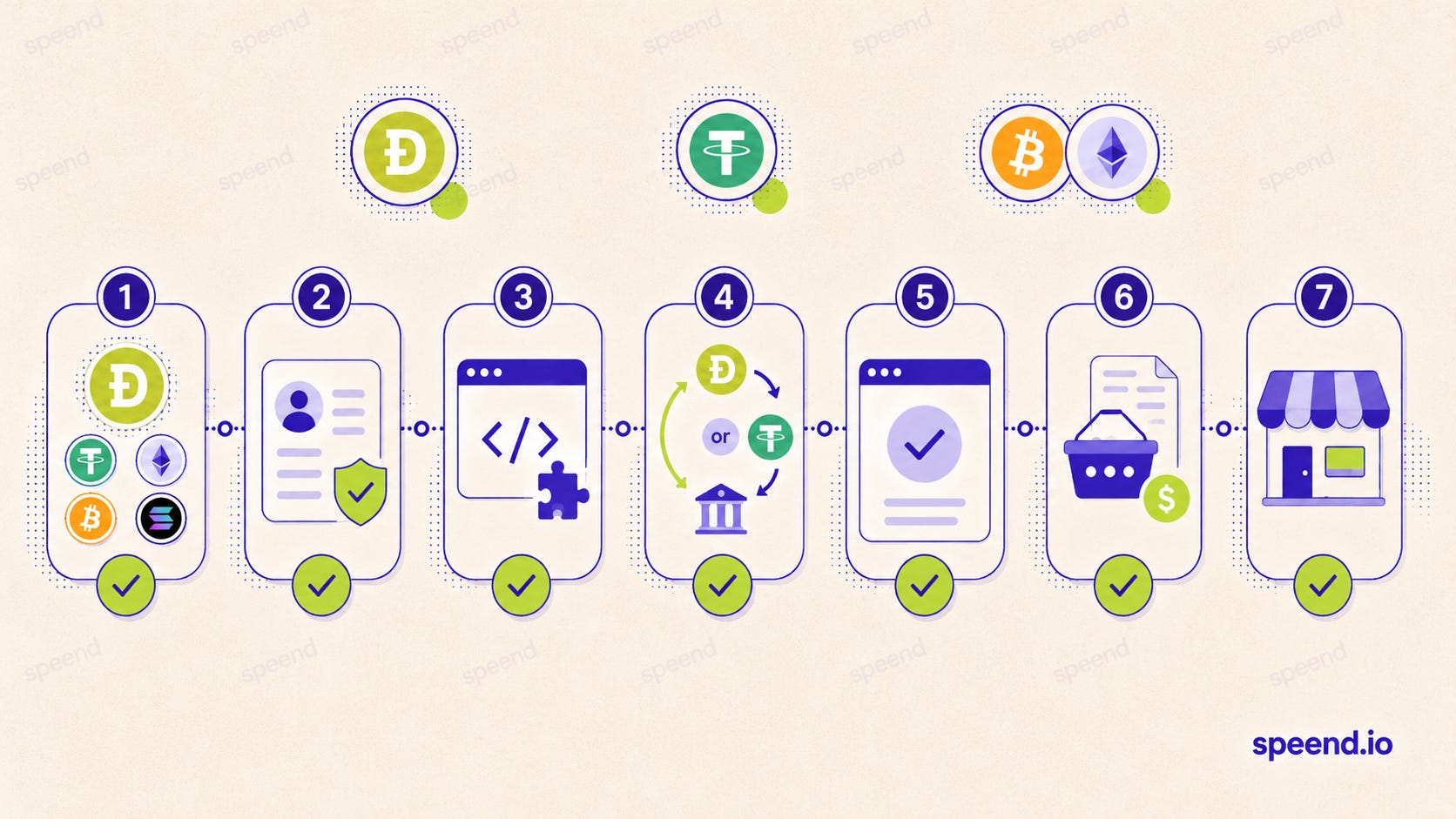
Technically, yes: a self-hosted node and a wallet are sufficient. In practice, most merchants run a gateway because it bundles the wallet, the conversion, the bookkeeping, the refunds, the tax export, and the customer-facing checkout into one piece of infrastructure. Building all of that in-house costs more than every gateway on this list charges combined.
What is the lowest fee for a Dogecoin payment gateway?
CoinRemitter’s 0.23% withdrawal fee is the published floor as of 2026. Most reputable providers cluster between 0.4% and 1% all-in. Speend operates at the low end of that range with no setup or monthly fees.
Does Speend support DOGE-to-USDT auto-conversion?
Yes. Inbound Dogecoin payments can be auto-converted to USDT or other supported stablecoins on the merchant account, removing volatility exposure for businesses that price and operate in dollars.
Can I run crypto payroll in DOGE through Speend?
Yes. Mass payouts and payroll workflows are built into the platform. A finance lead can run a payroll cycle in DOGE, USDT, BTC, or any of the 300+ supported coins from a CSV upload or an API call.
How fast can I integrate a Dogecoin payment gateway?
A working integration with Speend takes an afternoon for a competent backend developer. Hosted checkout flows are even faster: a non-developer can configure a payment page in under an hour through the dashboard.
Is Dogecoin payment processing legal?
In most jurisdictions, yes, when handled through a regulated or properly registered gateway. The merchant’s own compliance posture (sales tax, VAT, accounting treatment of crypto receipts) does not disappear because the rail is crypto. Talk to your accountant. Then sign up.
The bottom line on accepting Dogecoin in 2026
A dogecoin payment gateway in 2026 is a commodity in the sense that the basic function works at every reputable provider. The differentiation lives in coin breadth, settlement options, integration quality, support, and how many adjacent treasury problems the platform solves on the same contract.
Speend solves the most of them on the same contract. The other nine providers on this list each fit a narrower business case. Pick the one that matches yours.
For Dogecoin acceptance, mass payouts, crypto payroll, and 300+ coins on a single API: speend.io.